Overview
Payouts
Send mass payments to individuals and businesses quickly and compliantly
with the Payouts solution. Purpose-built for Enterprises and
Marketplaces to send payout disbursements in Southeast Asia (Europe and
Turkey coming soon), Payouts helps streamline the payout process and
ensure an intuitive, frictionless experience for your recipients. This
documentation is broken into distinct sections:
-
Introduction
- Learn how the
Payoutssolution is architected and the customer types that will benefit from implementing this type of disbursement product. Includes a deep dive on the supported Payout Models.
- Learn how the
-
Components
- Review definitions for important Components of the
Payoutssolution, as well as how they are used. This includes uP IDs, overviews of available transfer types and methods, details on how to fund your payouts and an explanation of thePayoutssolution’s standard reports.
- Review definitions for important Components of the
-
SFTP
- Understand how to setup your SFTP access and how your SFTP directories will be configured (this will be dependent on your chosen integration method).
-
Integration Ecommerce API
- Review important information outlining how to enable the
Payoutssolution using the Payments - Ecommerce API integration method. The Payments - Ecommerce API is the preferred integration method for the
Payoutssolution.
- Review important information outlining how to enable the
-
Payments - Ecommerce API Payout Reference
- This is where you will find detailed technical documentation for the Payments - Ecommerce API integration method.
-
Payments - Ecommerce API Webhooks
- Understand how webhooks can help increase visibility into your payment statuses.
Solution architecture
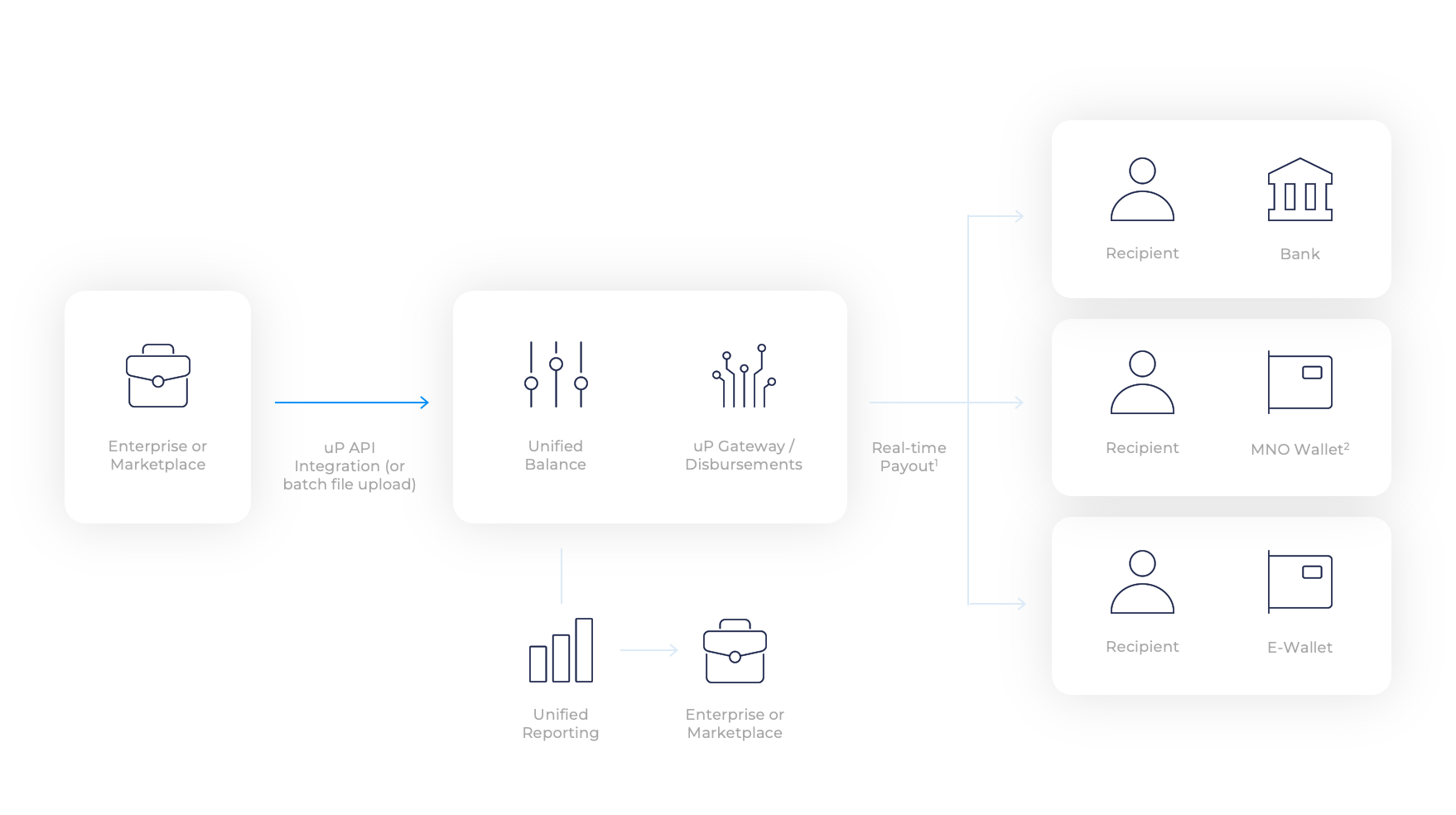
The Payouts solution is a standalone disbursement solution. It is built
on a Good Funds Model which means that your organisation will be required
to send funds to Nomupay prior to making payments to your recipients. These
funds will be deposited into a dedicated For Benefit Of (or FBO) Funding
Account. This FBO account allows Nomupay to safely and securely manage
funds on your behalf.
Funds that are deposited into your Funding Account are shown within your
Unified Balance. The heart of the Nomupay Platform, the Unified Balance is
composed of 3 sub-balance types: the Pending Balance, the Available
Balance, and the Reserve Balance. In the Payouts solution, funds that
are deposited into your Funding Account will be visible in the Available
Balance and thus can be used for payout activities.
When you’re ready to send mass payments to your recipients, simply provide Nomupay with the required payment instructions uP API, and the uP Platform will debit funds from your Unified Balance (removing them from your Available Balance) and, depending on the Payout Model that you’ve selected, either transfer them directly to your recipients’ previously onboarded transfer method, or send them to your recipients’ uP Wallets where the recipient will have the ability to initiate a transfer to an onboarded transfer method (see Payout Model section for more details).
As the owner of the Unified Balance, you can, at any time, withdraw any available funds and send them into your designated bank account.
Customer types
The Payouts solution can be architected to handle 2 customer types and
their corresponding use cases:
-
Enterprises and Marketplaces: Large organisations that have their own in-house payment infrastructure and are eager to technically integrate with the Nomupay Platform to improve their fee, reward, commission or claims payout disbursement capabilities.
-
Referral Clients: Customers that have a network of potential Enterprises and Marketplaces that they wish to refer to Nomupay. Referral Clients do not technically integrate with the Nomupay Platform themselves, rather, they assist the Nomupay team with relationship management and solutioning the proper
Payoutssolution. This could include consultants, industry associations, etc.
The remainder of the Payouts solution documentation will focus on
aspects of the technical integration for the first customer type
(Enterprises/Marketplaces). If you are interested in becoming a Nomupay
Referral Client for our Payouts solution, please contact our
solutioning
team
directly for more information specific to this use case.